📋 Strategic Field Note
- The Concept: "The Efficiency Trap" — optimizing for speed of input (learning) rather than robustness of output (competence).
- The Framework: Distinguishing "Vocabulary" (Static Knowledge) from "Grammar" (Dynamic Execution).
- The Case Study: Contrasting a 13-hour "Trading Mastery" course with a 360-hour "Coding Sprint."
Note: A narrative version of this essay was published on Medium. This version focuses on the underlying mental model and systems analysis.
I recently encountered a marketing hook that perfectly illustrates a structural flaw in modern learning: The 2-Day Mastery Promise.
The Input/Output Asymmetry
The ad promised to teach "Day, Swing, Position, and Investment" trading in a single weekend (12pm - 6:40pm).
This is attractive because it offers a High-Value Skill (Trading) for Low-Friction Input (13 Hours). However, this focus on speed often ignores the Net Life Hour cost of unlearning bad habits.

The problem isn't that the course is a scam. The problem is that it confuses Data Transmission with Skill Acquisition.
Analysis Framework
The Vocabulary vs. Grammar Framework
To understand why "accelerated learning" often fails in complex domains, we need to bifurcate "knowing" into two categories:

| Dimension | Vocabulary (The 'What') | Grammar (The 'How') |
|---|---|---|
| Definition | Static rules, definitions, syntax. | Dynamic application, pattern recognition, timing. |
| Transfer Time | Fast (Hours/Days). | Slow (Months/Years). |
| Chess Example | "The Knight moves in an L-shape." | "Identifying a weak back-rank in a chaotic mid-game." |
| Trading Example | "What is a Candlestick?" | "Managing psychological tilt during a 20% drawdown." |
💡 The Insight
Workshops sell Vocabulary because it is scalable and easy to package. But value lives in Grammar, which takes unscalable time to acquire.
Case Data: Coding Sprint (N=1)
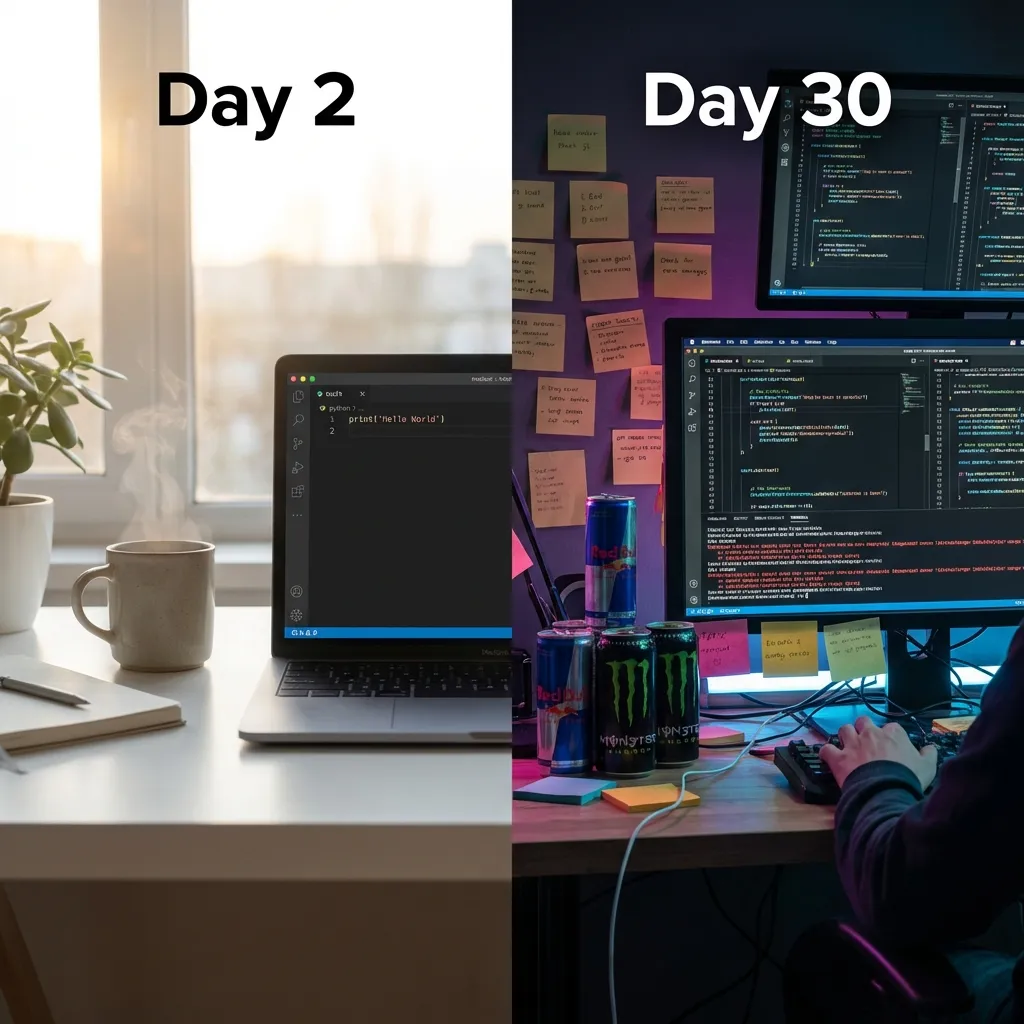
I tracked my own acquisition curve using Google's Antigravity agent to learn Python/System Architecture. The delta between "Vocabulary" and "Grammar" became apparent immediately.
The "Day 2" Plateau
By Day 2, I had achieved "Vocabulary Competence." I could read the code. I knew the functions. I felt competent.
This is the "Efficiency Trap." This plateau is where the Vibe Coder gets stuck—feeling like a wizard but unable to deploy. If I had stopped here, I would have intellectually understood coding but practically failed at building software.
The "Day 30" Reality
It took ~360 hours of focused work to hit the first "Grammar" milestone: debugging a complex Git rollback error without AI assistance.
The Structural Trap: False Confidence
The danger of efficient learning is that it constructs a Fragile Model of the domain.
⚠️ The "Exit Liquidity" Pipeline
- Input: User consumes 12 hours of high-quality "Vocabulary" content.
- State Change: User feels smarter (Dunning-Kruger impact).
- Action: User enters a PVP market (Trading) with real capital.
- Result: User encounters "Grammar" problems (Risk management, psychology) they have no framework for.
- Outcome: User becomes liquidity for professionals.
The "Map vs. Territory" Heuristic
When evaluating any "Mastery" claim, apply this heuristic:

🗺️ The Navigation Rule
- The Map (2 Days): Shows you where things are. Necessary, but insufficient.
- The Compass (30 Days): Gives you directional intuition. Allows for self-correction.
- The Territory (Years): The granular, visceral reality of the terrain.
Conclusion for Systems Builders
If you are building a system or learning a skill, optimize for Struggle, not Speed. If the learning feels "efficient" and "smooth," you are likely only acquiring Vocabulary.
True Grammar acquisition is messy, inefficient, and requires feedback loops that cannot be compressed into a weekend.
📚 Related Systems
- Gemini Gems Case Study
(Applying "Grammar" to build a diagnostic agent) - Project Athena Launch
(The output of the 360-hour sprint)
To see the practical output of this philosophy, view the Portfolio.